
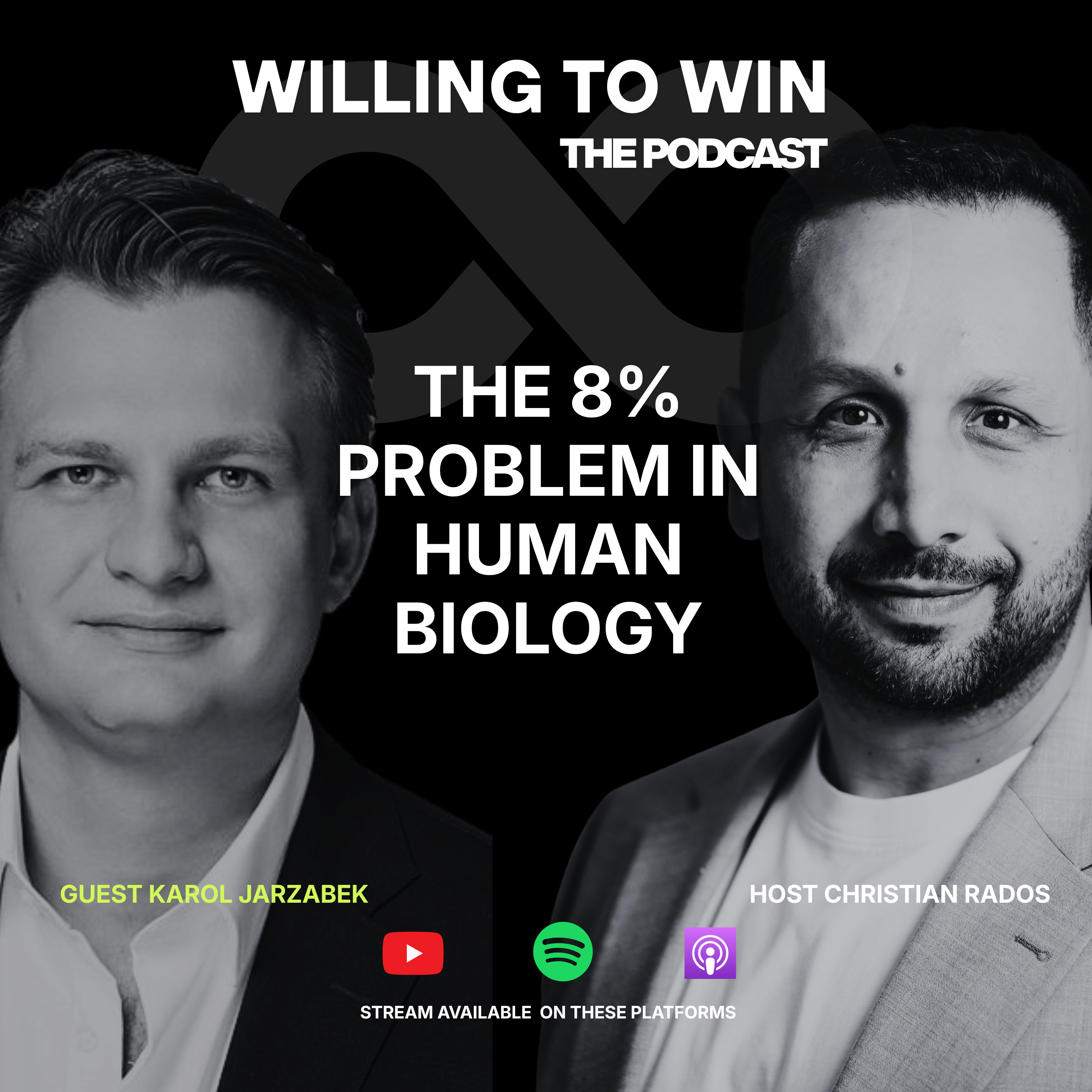
The conversation as it happened, lightly edited for reading. Christian asks, the guest answers.
Christian: Karol, you came into a new country as a child with a very strict mother. I think you said that once. How did it shape you in a good and a bad way?
Karol: Yeah, so listen, my mom had it pretty tough. I think she had a lot of ups and downs. When she was maybe 22, 23, we immigrated to this country, maybe two or three years after I was born, or at least she did. My dad came first. My mom came second. And they pretty much left me with my godmother, who was, I think, 19 at the time, for like a year and a half or maybe even two years.
Coming to a new country, my mom didn't speak the language. To this day she's pretty proficient now. But new world, new business, trying to figure out how to survive. My mom didn't necessarily know how to use the welfare state at that time. So it was all just trying to figure out how to live off your current cash flow. And my dad worked all the time and he was a truck driver, so he was always gone. And so my mother had two roles.
And I was always this high-spirited, high-strung kid that had a little bit of OCD. I was highly compulsive. Once I got fascinated or fixated on a topic, whether it was being outside or playing with Legos, I could do that for hours and close out the world around me. That kind of made me a bit of a pain point, because I never really followed the rules very well, even to this day, I'd say.
And my poor mother ended up having this uncontrollable force in her life that she was just trying to get disciplined and maintain. I wasn't easy to manage. My mom always said she had to grind down my horns every once in a while. It made everything that much more curious in terms of how things were going to play out. For a while there, my mom and I were kind of at odds.
And a long time ago, maybe 15 years ago, I started realizing that if it wasn't for her discipline and trying to guide me in the right direction, I wouldn't be where I am today. Some kids probably require a little bit more discipline, a little bit more focus, a stronger will to get them to act right, because if they don't, they could get off the rails pretty quickly. So I'm very thankful for my mother for everything she did. It was pretty painful at certain times, but where we're at today is just a fantastic experience.
Christian: How did she guide you in moments where you might have taken the wrong exit?
Karol: In a lot of ways. We were growing up in the United States in the nineties, latchkey kids. It means that the door closes and the door opens, you walk in and out, pretty much complete freedom. My mom worked till about 6 PM. I got home from school at three. And so I was just trying to do everything I could to not do homework, not do anything.
So my mother sent me to tutors. She hired tutors. I went to Polish school every Saturday, so I didn't have my weekends. It always felt like there was something going on where my mom tried to get me disciplined, with focus and structure all the time. And over the years, as much as I never liked that, I realized that having a set schedule and very clear habits and rituals is very powerful for me. Otherwise I'll just keep spinning and keep doing the things that I want to do and forget about everything else. And some things fall apart.
Christian: You also talked about not following the rules. Probably this is even more helpful right now than it is harmful. So tell me about that.
Karol: Yeah. So, following the rules, I'll tell you a story from high school. I was always a talker in class. You couldn't get me to shut up no matter how hard you tried. I was in study hall, where you have to stay quiet and study for the full 45 or 55 minutes, however long it was. And I would always just get in trouble with the teacher. At one point she said, either you stay quiet, or we're going to have to truly send you to the principal's office and you'll have a disciplinary situation.
I decided to pull up my chair next to her. And then I talked to her the rest of the year. That was me figuring out that immigrants have this way of finding loopholes to work with. I don't necessarily know how this works, but you can find a way of working around the problem. If you can't go through it, can't fix it, how can you get around it? Right? So funny enough, Becky Lee Carnes and I still talk every once in a while after 20 years. And she brings that moment up all the time. She says, I couldn't get you to shut up, and then next thing you find out, you decided to reverse engineer how you can keep talking.
I use that as an analogy for everything else that I've done in my life. I've had somewhat of a formal education, but with a lot of the challenges and roles I've tackled, I'm completely out of my depth in a lot of ways at the start. And one of the things you have to have, and I think this is a character trait, is this conviction that you'll figure it out. I may not know the answer, but I will do everything to get you the answer. And I'll be honest with my starting point.
That's pretty similar to where I am in my current role at iOrganBio as a COO. It's a robotics and AI company that does biology. And I don't have the depth in any one of those subjects, those domain disciplines, to hold a candle to the peers that I have in our company. But I'll tell you this much, I'll always figure it out. And the best thing you can do is ask a bunch of dumb questions. Being able to ask questions, learn, self-educate and figure things out is, if you find that in a person, whether it's an employee, a friend, a partner, it gives you an idea of how important adaptability is to different circumstances. It's a critical element. Whether you're born with it or you can develop it, everyone should focus on it.
Christian: I think you tested and you proved that personality trait along your career. What I see is you started, of course, in consulting, then went to pharma, orphan drugs, came into private equity and now you're at a startup that is a lot earlier than the other companies. There are a couple of questions running through my mind, but the first one is actually authority. That was the first bigger pharma company you came to, where you had to turn it around, shape it. What was the first thing you saw that others didn't, talking about rules and maybe changing rules?
Karol: Yeah. I joined Azurity when we were only $30 million of revenue, and I think there were only 40 employees. Four years from that point, we were at nearly half a billion dollars and 400 employees. A lot of it was inorganic acquisition and some organic growth that we had. I came in in a director of operations role, responsible for continuous improvement. I got connected with the company through consulting, and I was doing a consulting project to get their operation going.
My claim to fame, in terms of how I won favor with the CFO at that time, Ron Scarborough, who's now the CEO, was this. They were looking at potentially leasing another building, because their kitting line was through capacity. They were capacity constrained, and they just said, okay, we're going to have to get another facility, build a new line, hire more people. In about three weeks, I reverse engineered the challenges the team was having in getting the throughput going. Relatively quickly, and funny enough by eliminating automation, we were able to double the throughput.
So we didn't have to get another building, another facility, hire more people. I did a lot of cost avoidance for the company. At the same time I built out and cleaned out most of the GMP space, because they were also running out of warehouse space and pallet location space. I discovered that approximately 40 or 50 pallet locations on the floor could be freed up, because they just weren't organized in the right way to stage material as it goes in and out of certain work areas.
So I delivered for Ron a lot. And at that point I pretty much pitched my way into working for him, because he was one of the best executives I ever met. He was a great educator. The moment he saw you were a high potential, or had the ability to learn, he would dedicate his time and try to bring you up. He was very instrumental in where my progression happened, in taking these disparate domain functions and capabilities and skills that I had and helping guide and consolidate them into a really powerful general management approach.
So with Ron we then acquired Silvergate Pharmaceuticals. After that we acquired a few products from Eaton Pharma. And then we acquired Arbor Pharmaceuticals, which was in Atlanta, Georgia, in 2022, I believe. We grew real fast. I think Azurity is now a nearly billion-dollar revenue business with over a thousand employees all across the world. It's a great story to be part of that journey and cycle. That's one of my favorite memories of my professional career, the growth and the starting point.
Christian: There is a moment you mentioned between the lines. There is a moment in a turnaround when you realize, oh, it's working. Did you feel that moment? Did you celebrate it, or how did you feel it afterwards?
Karol: So when I came into Azurity, I fundamentally knew this was a company that I wanted to work for, because it had the right foundations. I didn't have a clear understanding of what my investment criteria were at that point or how to build an investment thesis, but I was able to pick up on trends and certain key points that said, this is a good business that has a lot of potential. I felt like I picked the right company to transition to.
It was when we acquired Arbor Pharmaceuticals that we had a generic portfolio of products that we never had before. And we had a lot of them. Initially we thought about divesting out of them. However, if you look at the unit volume performance as well as the financial performance for that portfolio of assets, it did nothing but go down and to the right for three years.
So one of the things I told Ron, and Ron and the board, was that no one's going to buy a falling knife. No one's going to try and catch a falling knife. They're all going to hose you on the purchase price and the relative value of that portfolio of assets. I said the only way we're going to be able to sell this is to stabilize the business and project some kind of raw strength and future value. So I started doing a bunch of investigation, looking at all the assets, the portfolio, understanding the complexities of generic contracts that exist out there, which is a total web. If you ever dive deep into it, you realize how complex the US pharmaceutical commercial space is.
After about a month of diligence on the entire business, I made a pitch to Ron. I said I'm going to need to buy about $5 million worth of inventory for certain products which I think have a high likelihood of being successful, because they're differentiated, there aren't too many market participants, you've got the right gross margin profile, and there's enough demand out there to justify taking a gamble. And I started building out a small team. It was a skunkworks team. We had four people that were pretty core to the team and we were constantly trying to clean things up.
One of the things I realized was that we were far off from our pricing in relationship to the market. And I didn't have too much time, because as soon as they gave me this portfolio of products, I had to start diligencing. I started getting diligence by potential buyers, which is maybe a three or four month cycle, and I had to figure out how to turn it around.
One of the things I did was a relative sample assessment across different channels of customers, picking prices and figuring out, go high, go low, go medium across different products and ranges. I realized that because you have such a big portfolio, so many SKUs and so many potential channels you could go to, you can do a lot of experimentation really quickly. By getting clear benchmarks on where we get traction and where we don't, and when someone asks for additional negotiation, I'm like, okay, I'm in the ballpark. That was the approach for probably the first three months of the business, just trying to understand market price dynamics. And we didn't win a single thing the first round that we did it. Not a single one.
But we got a lot of insight. And in the second tranche, out of Q2 of that year, we got significant traction. So much so that the portfolio of assets that I'm talking about was probably generating just $20 million before we acquired the portfolio in general. And the moment they gave it to me, I lost about a third of the business because products were up for negotiation. So now I have a business that's probably $12 million in revenue, generating negative EBITDA, and I have to go sell this. And no one wants to buy that. Right?
So after the first quarter of little to no success in this experiment, in the second we hit big and we were able to get back on our runway of delivering the $26 or $27 million that I forecasted at the very beginning. And now I believe that portfolio is generating over a hundred million dollars of net revenue. There are new products that were added. It's not just all the work that I did. We also had a great team that came on and found a solid replacement for me, because as soon as I was able to do that turnaround, my investors asked me to come work for them. So we hired Nate, who was leading that division after I left. And he's done a fantastic job in getting commercial traction of that portfolio.
Christian: In the beginning you said you didn't have a private life, you didn't bother, right? It was not a big problem. Probably you wouldn't do the same thing right now.
Karol: No, no.
Christian: Your private life, I guess.
Karol: Yeah, no, listen, you have to understand that there are very few times in life you can get a win-win. A lot of times you get trade-offs. Growing up as an immigrant, trying to make it in the United States post-2008, anytime you got a job, you were lucky if you got one. Everyone had the hustler cut, the grinding culture. Everyone talked about how many hours they were working. That was a way of showing, hey, I'm okay. That was our time.
Christian: Yes. That was our time. Right.
Karol: And I did that for probably 10 or so years, where I was just constantly grinding. I realized that the fastest way I could pay off my student loans and get a solid footing was through consulting. I realized I don't need any overhead. So I got rid of my house, got rid of my car. I literally lived in hotels, and yeah, you pay a price in terms of personal life. I started in my mid thirties to try and find a partner and get stable in one community. But I wouldn't have had the success that I have today, and I'm not talking about the professional, vocational side. My wife is the treasure of my life, and the community that I have here in Raleigh, as well as with her family, is the biggest gift.
I wouldn't have had it any other way, knowing what I know today. In the moment, it obviously sucked and it was very depressing, but it was a trade-off that I decided to take, and it enabled me to do other things in the future. It comes back down to being able to figure things out, being adaptable. How can you stabilize in one point, grow in another, but some things are going to fall through the cracks. So that's what it was.
Christian: What part was depressing?
Karol: 330 days in hotels. At that time I had two of my own businesses. One was an export business and one was a consulting business. You're constantly traveling, working with clients, trying to figure out how you're going to make payroll and pay some of your contractors, or how am I going to acquire enough equipment to sell. I was constantly traveling and trying to make it right. But it taught me a lot of different things: supply chain, hardcore logistics, customer acquisition, figuring things out, not knowing anything, building out your own acumen in QuickBooks, accounting, finance, even more so understanding how tax structures work, because now you're running a business and you've got multiple sources of income. So it was very educational, but at the same time just pretty depressing.
You don't see your friends. Your closest friends are living their lives. Everyone's moving on. And you're in the same hotel room. Sometimes you get a phone call, you're in the middle of Canada, and you answer it in Polish because you think you're in Warsaw. Next thing you find out, you've got to fly to Dallas today. Somehow your brain is across too many geographies, trying to focus on too many different things. A lot of times it's not sustainable.
I think the problem I had back then is that I really didn't know how to scale. I was growing up with an immigrant mentality: I can figure everything out, I can do everything. And that is not true. If you want to reduce your trade-offs, you need to accept lower margins and be able to take on higher expenses. That's just how life goes. And the more you learn from your mistakes, because I'm an experiential learner, the more you can apply in the future.
Christian: That's an interesting part. So exploratory mindsets in times of uncertainty. So you changed companies afterwards, to private equity, the investor you said. Then you didn't have to change one company, but being the outsider, changing other companies, a lot of uncertainty. You wouldn't be able to control certain companies.
Karol: No, and here's the funny part. As an investor in the business, even though you're operating as an operating partner or have the operational responsibilities, those companies don't have to listen to you. Those leaders don't have to listen to you. So you're constantly in this sales cycle of advising them to do the right thing or helping them see things that they don't see, helping them see around the corners. It really tells you how important strong management teams are. If you've got a strong management team, you can sleep easy at night, not have to look under every rock or over their shoulder all the time to know what they're doing.
I really wish that more investment committees, and it was much more acceptable, would say, hey, this is a strong founder or a strong management team, and you build your investment thesis around that. Yes, the industry, the space, the CAGR, the growth, all that stuff is super important. But after you buy it, someone's going to have to run it, and you want people that are good to run it. To make the assumption that you can always find the perfect team is pretty risky.
Christian: Let us dig deeper a little bit. As an outsider, as an investor, you said you have this sales approach. You have to have influence without having real influence, you have an advisory role. I believe that sometimes you are perceived as a threat by the people, depending on the relationship, depending on the personality of the other side. Did you experience that?
Karol: Of course. Of course, being a villain. The joke someone told in our company is, if Karol's working with you, it's not a good sign. I don't think it was always the case, but my partners didn't give me the easy work, and that's how it should be. So being seen as somewhat of a threat or an unknown factor, as in, oh, he's going to call mom and dad, that kind of risk is always present. But it's all about how you deliver, and how you gain trust is the one thing that matters most.
Anyone who is intelligent will appreciate anyone that can help them out. It's a no-brainer. Could you help me carry the load? Yes. Okay. And I have no problem getting my hands dirty. You need me to do some business development, figure out what's wrong with our sales funnel or our messaging that's falling through, or our financials or our operations, our strategy? It doesn't matter. There are so many pieces, and back to the point that you can't do it all yourself, you fundamentally need that. If you have someone that's willing to be in the trenches with you, I always see that as a positive thing.
It's not always well perceived by others, but I think a lot of that comes down to the human factor, ego taking a part in everything that we do. You can't discount that in business or interpersonal relationships, or even in castle politics. There's a certain level of ego. And one of the things I truly appreciate is individuals that have a certain level of ego death. I'm not the best person, I don't know everything, and I am willing to get help from anyone that can help me out. I love working with those folks because there's a certain degree of authenticity. In a world where everyone's got their shields up and is trying to show off perfection at all times, you realize that's a lot of cycles to dedicate when we all know that it's impossible to know everything and be perfect.
Christian: When did it change on your end?
Karol: When did it change? Me trying to be perfect?
Christian: Trying to keep your ego up.
Karol: Oh, that one's actually pretty easy. One of the things you asked me when we last met was what was one of the hardest things you had to deal with that you don't talk about in the business world. The reality is that at its core, I have made it a very big part of my life to be as authentic as I can be. Ever since I was a kid, I didn't want to change. I didn't want to adapt too much to teachers and mom. I really like my authentic self, because it's playful, it's fun, it's hardworking, it's pressing. I want to build meaningful relationships with people. I looked at most of those things as being relatively good.
But in a world where everyone's putting up a perfect shade of themselves, no one really wants to bring down their barriers or their walls. So it was always a very intentional thing for me to be as authentic as I could be. A lot of times it didn't work out well, especially in my early career. Everyone was like, oh man, this guy's got too much energy, why is he trying so hard? But at its core, that's who I was. And the funny part is that people who were dismissive of me at first really ended up connecting with me over time. That's the main reason why I still talk to Becky Lee Carnes.
Christian: I remember you.
Karol: Right. And the same thing with Rob Yates from my days at Bosch, my first job after school. Him and I still chitchat from time to time. He'll tell you that when he first met me, he thought, man, this kid's a little bit too much. He dismissed me. And then over time we built this great friendship together. I'm one of those ride-or-die people. Most of my friends I've had for 20 or 30 years. I still try to stay close to the people that I've made these relationships with. What allows you to continue that over time is a certain degree of authenticity, and you've got to keep it. For anyone who's trying to be something that they're not, eventually it falls apart. It's just a matter of time.
So the more you can be relatively true to yourself, the less you're putting in the cycles. You have to improve. You can't be a complete narcissist, so there are certain things you've got to watch out for. But at its core, by being a good person, a person that chooses to be great, that chooses to be kind, that chooses to be helpful, and at the same time just tries to be relatively positive, man, that is something you want to keep regardless of who you are. Whether or not it got me burned when I was younger and a little bit too comedic at times, the older I get, I've found a way of differentiating myself at all times. And I don't have to pretend to be someone I'm not. I think that's a major weight off anyone's chest.
Christian: For example, scientific founders in biotech companies. Their ego is attached to their identity. The science is attached to their identity. If someone says something about the science, they would, of course, take it more personally than in any other role. Identity, I think, is different in what you created.
Karol: Yeah. It kind of comes down to, I don't know if you can apply first principles to personality, right? But your personality in some way is somewhat dictated from your birth. You can adjust on the fringes a little bit, but very few people can change who they are fundamentally. You don't have too many examples. But when you do, they're these amazing stories that you hear.
When it comes down to scientists, the hardest thing I find with people that have a lot of domain experience in science is that you've gone really deep into one core topic, usually. Whether it's a branch of biology, and the moment you go down biology there are smaller tranches that you go down, and then you build certain expertise. Very much like doctors, you're within the same ecosystem at all times, and you don't get too many points out.
And I think the hardest thing that a lot of scientists have, to your question about value, is this. If you can't communicate the value of what you're working on effectively to others, or understand the relative value converted into a monetary point, it's very hard not to be rooted in some degree of ego about your ideas. I'll give you an example. I always tell a lot of scientific founders that if someone offers you a stupid amount of money for what you're working on, just say yes. Sell.
I think a lot of scientific founders overvalue what they build, or what the market perception of what they build is. What ends up happening is they'll say no, they'll get another offer, they'll say no again, because it's not what they perceive it to be. And then eventually the money stops coming. They run out of funds and the idea goes away. Then it gets acquired through legal means, or it goes back out in the market. I think that's a sad tale, for someone who's built something with their craft.
When it comes down to the space of pharma, you're talking about these long development cycles. Some products take literally 26 years to make. It takes longer to make a pharmaceutical product than it takes to get an F-35 up into the air. You don't have this appreciation of what the relative value is, because it's the world's worst casino. 26 years to find out that, hey, you know what, we're going to take all your money away, is a crazy notion of failure. And I think it's partially because you don't have routine exits in this space. You have either a winner takes all or nothing at all. It is so bimodal as a distribution. Either you have these billion-dollar transactions that are in the news, or another company went bankrupt, or got acquired for pennies on the dollar. And there's nothing in the middle like you have with a lot of other industries. I think that is fundamentally one of the challenges that scientists end up having, miscalculating the value of what they're working on.
Because no one really understands the compounding effects of risk and potential probabilities of failure, year in, year out, on a cash investment basis. None of these products in our pharmaceutical industry have a positive IRR or a positive NPV. That's the crazy thing that most consumers in the United States don't understand when they attack the pharmaceutical industry. None of these things are relatively profitable on a cash basis in terms of investment. They'll just see that a product is making 10 billion, 12 billion dollars a year. But they don't know that the company had to spend 40 billion dollars to get it approved, because of all the other products it had to work on just to get that dollar amount of magnitude. If you don't look into the numbers, it's very hard to be sympathetic to pharmaceutical companies, and I get that.
Christian: What's the problem actually with biotech?
Karol: The real problem in biotech is we really don't know anything about biology. That's the scariest thing. If you look at the probability of getting a drug approved, the probability of success is like 8%. I use that as a corollary for how much biology we probably understand as a society, as a civilization. It's like 8%. And I would say the number is low.
Christian: 8%?
Karol: Yeah. That's the likelihood of getting a drug approved. If you put a hundred drugs into clinical trials, only eight of them will get approved. But we look at human biology as if health is neutral. Being healthy, not having any issues, is a neutral position. There's more above that, especially now that you're talking about neurotropics and peptides, and the world's getting crazier in terms of potentially human enhancement, all that stuff. There's more to discover about biology than we understand. But in terms of getting us to healthy, we probably know about 8%.
The reason for that is, if you look at the people driving most of the innovation in our space, our best and brightest minds, these poor biologists, these PhDs, are doing wet lab work 75% of their time. Pipetting, moving things around, playing around with shakers. And what they don't tell you is that most of it's rework. The moment I discovered that, I thought, what a misallocation of human capital. Think about that, Christian. Most of the growth that we've had in GDPs and civilizations across countries and across time has really been about unlocking humans.
So if you start thinking about where our best and brightest are at, they're spending 75% of their time doing rework, trying to move biology forward, discover how it works and operates. Some experiments take three to six months, maybe longer. You add the rework. By the time you get a successful outcome, it's two, three years. Okay, now I've got something I can work with. Cool.
The terrifying part about that is that misallocation of human capital is really the root cause of why we know so little. And the more that persists, the lower the likelihood we have of flipping the script, turning this industry, which is a casino, into something that's predictable. Think about SpaceX and the space industry, using engineering, CAD, all these fundamentals that they've built over a hundred years of the industrial revolution, and before that. They've been able to unlock and build rockets. Do they experiment? Yes. Do they go up in the air the first time? Maybe. But they fundamentally work. They can get to a certain level of precision on their version ones that gets you to a point of, this is possible. In biology, we ain't got that.
We don't know how the cells behave in real time, because they're self-organizing, they're finicky. If they're in the wrong environment, the wrong humidity, temperature, you don't shake it enough. And maybe you're not telling it that you love it enough. I have no idea. There are so many different variables that go into it that you start asking the question, okay, so what drives biology? We have hypotheses, we have ideas, but at its core we know very little.
And as much as everyone's really hooked on space exploration, the total addressable market, all these investments going into SpaceX and rocket companies, and trust me, I think that's wonderful, the TAM for biology is larger. Because the moment you get to another planet, the question is, how can you have biology be there? Whether it's plants, animals, humans.
Christian: So what happens when you go from 8%, let's say, to 20?
Karol: Back to that, the probability of success for drugs getting approved is 8%. Here at iOrganBio, we're using robots and AI to do cell differentiation. I talked a little bit about the pain point of biologists being a misallocated human capital. If you were using robots and AI to unlock that time, they would focus much more on the design of experiments and on assessing what to do next with the biology, while the robots and the AI do most of the heavy lift.
At the core, what we use is single cell transcriptomics. It's probably one of the most data-rich insights you can get into the state of cells. And our cycle times, from collecting samples, library prep, sequencing, all the way through analysis, are a little bit over 24 hours, which is world-class. I don't think any single company has that ability. What we've fundamentally built is an engine that unlocks our data acquisition of what's happening to biology in real time. I believe we can get to 20% as quickly as we can.
And what happens at 20%? I think in 2023 the top 20 pharma companies spent about $145 billion on R&D. That reflects the 8% probability of success. So 92% of what comes out of that will go into failures. If you had something that understood biology, and you were able to raise that probability of success to 20%, you would have that same run rate of $145 billion generating two and a half times as many drugs. Or you can deliver the current number of drugs at $57 billion.
So there's this wealth of opportunity. You can fundamentally change the unit economics of pharmaceuticals just by making it predictive. The way we go about drug discovery is fundamentally guess and check. Let's guess and check whether this drug is going to be efficacious and safe. We have all these controls, all these factors, clinical trials, preclinical animal testing, you name it, to guide you along that guess and checking. But at its core, if you were able to make something much more predictive, you change biology into a controls problem and you have predictable outcomes. You've now fundamentally changed the entire game of how the unit economics work in pharma.
Christian: I also believe that we would have a lot fewer biotech companies at all. Because people wouldn't go on the journey if they knew much earlier that this isn't going to work.
Karol: You know, I would say that you'd actually have more. It's one of those interesting points. Back in the day we used to have hand looms, and everyone immediately thought, okay, I'll be able to deliver more goods at a higher price. But what happened was the consumer benefited. The people that were working on looms were kind of the losers, but you ended up having all of these different new players. The clothing industry is significantly larger because it's able to satisfy more demand.
If you have more predictive outcomes, you would have better capital efficiency. That's what you would have. But you would have more biotech companies, because the more you understand about biology, it's almost an infinite space of where it can go. Not only in terms of human health, but animal health, plant health, a gain of function of our character traits. And when you take it one step further, what if you were able to use biology for material applications? Everyone's talking about these data centers. One gigawatt is very expensive to purchase these days. Your brain has more compute than most data centers and it operates on 10 watts. It's one of the most effective transistors that we have. Down the road, I wouldn't be surprised if you end up with a symbiotic relationship between material science and biology to drive better levels of efficiency. I think there'd be more biotech companies. I really do.
Christian: Interesting. I just think about the invention of email creating more paper demand.
Karol: Yeah, that's a good point. I didn't know that.
Christian: One important question that I have here is, you went to iOrganBio after all your time in private equity. Why?
Karol: Man, that one. Back when I was a consultant, I met a bunch of PE guys and I thought, I want to be that guy. At its core, the times that I felt happiest were when I was building companies, not when I was advising, not when I was consulting. It was when I was driving some value through my team and through myself. So when I got into PE, I just knew deep down inside that this is probably not my place. Being relatively honest with yourself and knowing that is pretty important. Back to being somewhat authentic. You want to be as authentic to yourself as possible because it's just easier to live with.
Christian: But you wanted it.
Karol: You don't know until you try sometimes. And a lot of times it was a cool gig. I am very thankful for the time I had in PE, I want to make that super clear. It was such a great education, because we were all in the pharma services space, everything from end to end. You had CDMO, CRO, post-commercialization, patient support companies, and we were constantly looking at the full value chain of pharma and seeing how all of it works. I went from oil and gas and aerospace to Azurity Pharmaceuticals, my first pharma gig, four years, and had to learn a lot. A completely complete novice. I had no idea how some of these pharma services industries work or what the core competencies are that build the pharma operation.
So being able to see that entire swath was very helpful in understanding how to build the right investment thesis. How do you realize value of something? The beauty about it is that I now know gross margins for most industries, so it's easy to negotiate. I know what the levers are. I know what the market dynamics are, what the strategies are, where they think their growth is going to be. That's pretty powerful, especially now that we talk about customer acquisition here at iOrganBio. It helps guide me, because now I'm an expert in the space who understands the strategic levers that they're trying to pull on, and hopefully it'll just generate more share.
iOrganBio is me learning the hard stuff that I never had a chance to get. Biology, the importance of R&D, understanding how that engine works. Right now we're still very much in the R&D phase. We have commercial traction, but there's still so much that I have to learn to be effective in my role, and that is super powerful in terms of being able to build a comprehensive package. At my core I am a general manager at heart. I'm an operator, and I'm working on filling out the deficiencies because I fell in love with the space.
Figuring out how to fix this industry is one of my biggest drivers. When I was putting together these damn financial models for whether or not we buy or build a product, I remember when I started looking at this stuff, I thought, I'm getting thousands of data points from regulatory, clinical, R&D, tech transfer, operations, quality, and I have to consolidate them into one number. And I know that no one in this industry knows everything. I also know from my own personal experience that I have made mistakes in assessment, not knowing enough. So there's a certain level of error in anything that you're receiving and then trying to put down into a number.
For me that was, oh, if you could figure out how to solve this problem in our industry, you change the game for a lot of people. You push biology and human health forward, and because you can get the unit economics, you can make capital markets more efficient in generating a return. That efficiency eventually gets passed down to consumers, to patients.
So joining iOrganBio was me really trying to pursue something. I want to get the early-stage startup milestone box checked. I want to help build something, do R&D, do biology. It's also tied to something that I am so passionate about, truly being able to have a better understanding of biology, a clear picture of biology, benefits everybody. I don't know if we're going to be able to deliver the perfect view, but if we can just get it to 20%, you change the lives of a lot of people. That is my mission, my goal here at iOrganBio.
One of the easiest criteria for me in making that decision was actually our founder, Daniel Delubach. He's probably one of the smartest people I've ever met and probably one of the best operators I've met too. It's been a humbling experience working with the guy. A lot of people would look at that and say, man, you could have gotten a CEO role someplace, or stayed in PE, which everybody says, why the hell did you ever leave, my dream job, all the time. And I'm like, listen, I just want to be surrounded by the best possible people that have the same vision and mission I have.
The older you get, the less time you have in this world, and a few more bucks isn't going to make or break it. What's going to make or break it for me, and I think everyone's values are very different, but back to being authentic, is this. A life goal of mine ever since I was a kid is I want to write the best story I can. The best story that I can possibly write, and I have to write it with my experiences. So I am looking for what's going to have the best story, the best cliffhangers, the best peaks and troughs, you name it. That is my motivator, and pursuing self-actualization as a human being.
Christian: Love that. And to end on, what is something that you are determined to avoid at all costs?
Karol: You know, I met my wife relatively late in life. I want to be able to spend as much time as I can with her. So for me it's about eventually having the right balance. More than that, she has a family history of Alzheimer's. The saddest thing I could think of is if my time gets short with her personality. The work that I'm doing at its core is also to enable her longevity and her health so we get more time together. So that's the one thing, that would be the biggest low point, not being able to help her with that. And the best one would be that I help enable her health and her longevity and her life, because she's an incredible person.
So from a personal side, that's that. From a professional side, I think the next goal for me is really working much more with legislators to help address some of the challenges that we have in the regulatory space with trying to get drugs approved, and how we can make things run smoother, not only from a drug discovery and drug approval basis but also from a commercial basis. I think that's the next big stage that I'll eventually be working on. And if I can help unlock that, then, it's an industry that I love, and I find it super complicated. It's like you're playing with a Rubik's Cube all the time, and because you're dealing with people's health, it's always personal.
Christian: That went to my heart. Thank you very much for this conversation, Karol.
Karol: Thank you, Christian. It was a pleasure. Thank you so much for hosting me on your podcast.
If you think you need to talk to this guest, reach out to me and I am happy to make a connection. Christian Rados, christian@rados-recruiting.com
All episodes and the problem pages