
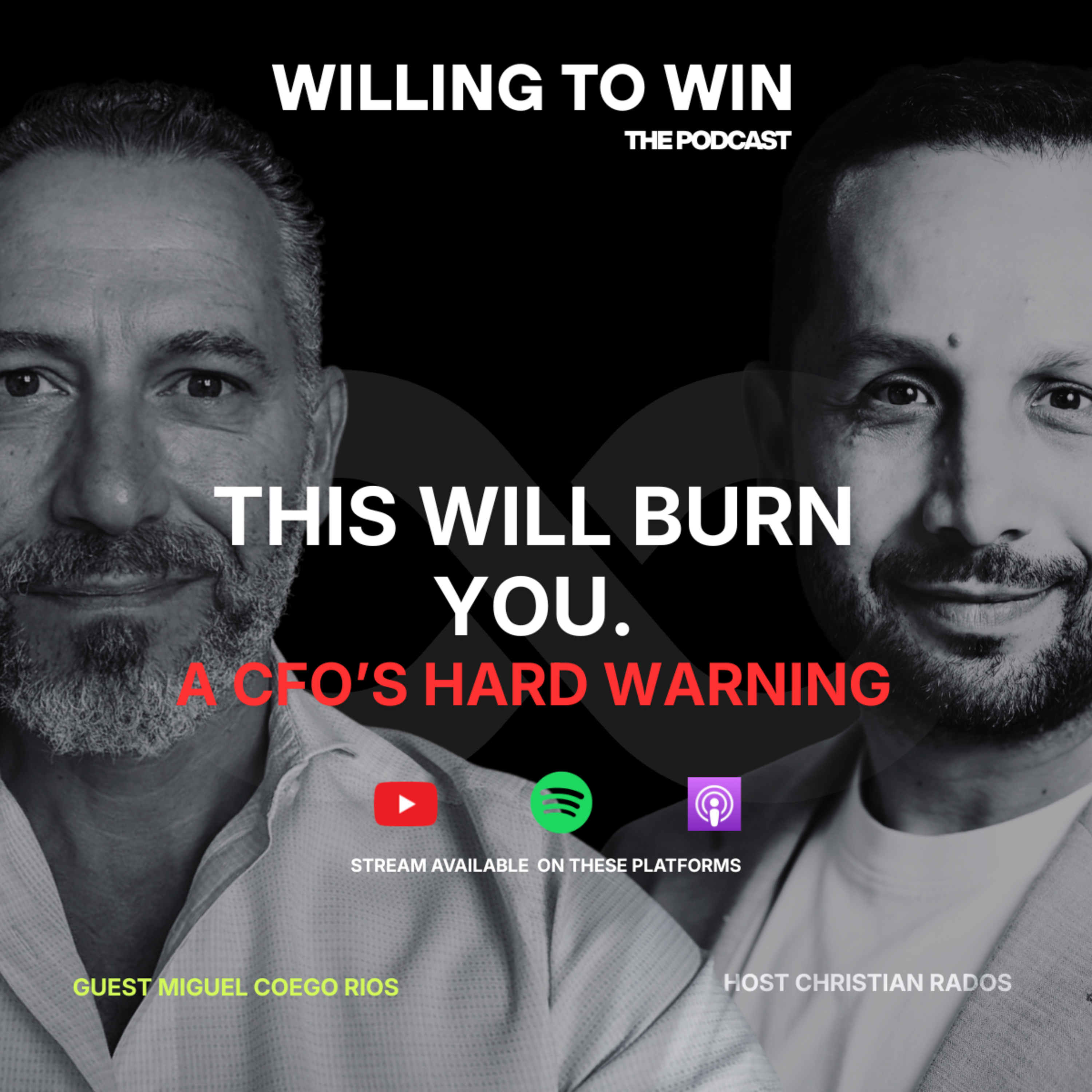
The conversation as it happened, lightly edited for reading. Christian asks, the guest answers.
Christian: I believe you learned a lot about resilience over the last 20 years. So tell me what resilience means for you.
Miguel: Being honest, I think it is far beyond work. At the end, if you manage to get a good level of resilience in your life, through experiences, through attitude, you name it, DNA even, at the end you are able to show it at work or to use it at work. If you, I'm going to get a bit deeper, but if you are looking for getting resilient only at work, it may be not the right setup to get that strength. Better to get it in life and then apply it at work. When you are fully trained, then at work it will be fine.
Christian: Tell me more about that. Where did you learn the resilience?
Miguel: My life has had a lot of experiences, not always good or something that you would be happy with. But at the end, childhood may have a lot of challenges. You can have a lot of things that go not so well. But at the end, that makes you become a stronger person. And when you get to work, then you can use all of these once more. If you get to work already sorted, ready to accept whatever may happen, then you can succeed. Then you can enjoy it even, or put it into scale, in perspective.
Christian: Can you give me an example? You mentioned something now, maybe from childhood, maybe from early adolescence. Can you give me an example?
Miguel: Look, that is going to be a fun one. I was a very bad student, terrible student.
Christian: Really?
Miguel: Yeah, yeah. Even had to do one year two times when I was 14, which is something quite weird. And probably my route was starting to be designed not to be successful at work. Then I had the chance of moving to Scotland, finish my degree there, and start from scratch. I thought it was scratch, but at the end, obviously, all the experiences that I had, I had it in my backpack, even without knowing.
And then when I started working, I found a different person saying, oh, wow, I have a big potential, I have ambition, I want to learn, I want to do things. But obviously, everything that I had endured in these first 25 years, let's say, it paid back, because every time that I have to face some difficulty, compared to what I have experienced back in the days, it is nothing. And again, that is for life, it is not for work. But you have to have the full view of what's going on. If it is only work, it is only work. But if you have had the luxury, let's say, even the privilege of exploring and having a lot of difficulties in your life, then it's when it really makes sense.
Christian: Were you forced as a young child to be stronger than other kids?
Miguel: Oh, yeah. A lot more, a lot more. Funny enough, I have spent most of my career in rare diseases, and my dad had a rare disease.
Christian: Oh.
Miguel: 1980s, it's called panarteritis nodosa, ultra rare. And I experienced the typical path of a rare disease patient, 10 years until diagnosis. Once it got diagnosed, no solution, no treatment, no drug. So as you can imagine, when it comes to the family, that was a big impact. And again, thinking of the 1980s, no resources, nowhere to be found. So without knowing it, that was a very hard experience. Again, when I put this in perspective to what I have to face at work, that becomes 10%.
Christian: Of course.
Miguel: It's nothing. You can get dragged into this day to day and feeling, oh, wow, that is super important. Oh, we are going to miss the budget in a month. But if you step back for a second and say, okay, what does that really mean? It doesn't mean that you will be laid back. But it means like, okay, I can handle this. Of course I can. I have handled much tougher.
Christian: There is a word in German, it doesn't translate really well in English. It means self-efficacy, the expectation of self-efficacy. So I think that is what you say. You had some challenging experiences, and based on this you are going to tackle everything that is going to be in your way.
Miguel: Absolutely. And on top of it, the experiences will happen. Everybody has experiences, childhood, whatever. There are all kinds of situations in life. The way you face them is one thing, and you may be able to do it or not. That is one aspect. But then at a certain point, when you become an adult, you need to work on that. You need to process them. You need to integrate them. You need to understand them. Because when you clean them up, let's say the bad part of them, then is when you can get the best outcome. In so many occasions, you can go through traumatic events and without processing them, you will drag them. You got trapped in the lift when you were five, then you are 80 and you react to the lift in the same way that when you were five.
So at least for me, and it worked really well, it's okay. I had all this series of events. When I got to a certain time in my adulthood, I was struggling. Personal relationships, work, et cetera. So it's okay, now it's time to start working on myself and understanding all this, why, why not, how to face it, how to embrace it. After all this process, which took me a long time and I'm still ongoing on therapy, then you can start enjoying how much stronger you are, how grateful you can be of all this stuff. I mean, it is what it is. Life is only one and you cannot choose family or you cannot choose health or whatever other aspects.
Christian: I think in your life, responsibility and having to face different challenges have always been a real topic. It can drain you in some way, but it also gives you purpose, right? It always depends on where you focus your attention. So now you're CFO at AOP. But let's look at 15 years back. What kind of focus did you have as a person back then compared to now?
Miguel: Probably I would be able to talk about both person and professional. Professional, I was very ambitious. I was looking for, I didn't know what, it wasn't the money or the position at all, but clearly it was a lot on recognition, and that is what it links with the person I was. Obviously, 15 years ago, 20 years ago, now I see I was lost or I didn't have a very clear route where to go or why I was doing things. Probably the key aspect is why I was doing things. I was ambitious. I wanted bigger jobs and I wanted progression of my career. Then why I wanted it, now I know, that again, this recognition, this tap in the back, a well done, that again connects very much with that childhood.
It was my driver. It was pushing me. It was never enough. Funny enough, when I was talking to friends, back in the day I was maybe CFO for Latam of a company, 750 million. I mean, quite a big one. I was never able to say... My friend could ask me, what is your job? I work in finance. Because I didn't really connect to that person.
The fact that I was looking much more for the recognition or the validation than the job per se, it created that disconnection between the two sides. So that's why, yeah, personal and professional are always connected. You cannot separate them completely. But all the effort that I did was to understand the why, why I was doing it. Now I understand. And obviously now I face it in a different way. I love what I do. I love my work. I love my position. I can make a difference in many aspects. But now I know why I'm doing it. And I'm fine with that. And I'm much at peace with that.
Christian: Can you share how you found that?
Miguel: Finding it, in my case, was full traditional psychological therapy. Which still, when we talk about this, nowadays in 2026, we need to embrace it. And we can talk about this later, because the focus is always about technical skills. To some extent physical strength, and you need to train them. What about emotion? It's coming step by step, but it's still embryonic in my view. When you look at LinkedIn, you will see ultramarathons and shit like that. What about emotions? Where are they? And I think that is a big thing.
So in any case, today my why is about, in a very humble way, trying to help my team massively. That is super important. And it's not a sentence. I really mean it. Worry about them, how they can get better, independently of whether in three years they work with me or they work elsewhere. That is a legacy that you can leave. Helping the organization as a whole. I mean, luckily I am in healthcare. So when we do better, we do better for patients. And that is something I have in my mind. That sounds also pretty standard, but again, it connects once more with my experiences with my dad. It really means something. I had the chance on many occasions of meeting patient associations, that is, actual patients. And then you touch it. You touch the end of the chain. We don't build screws or machinery. Oh, it's a fantastic, beautiful job. But in my case, yeah, probably the why is definitely a big chunk of it. My team, my colleagues, and ultimately the people you serve. And that's it. The validation, the recognition, all that stuff. I went much further than I could have dreamed. I've never thought that I would go that far.
Christian: So significance drove you a little bit until this point.
Miguel: Yes.
Christian: But now you're talking about contribution, contributing to your team, contributing to the patients. So let's talk about the patients. How do you remind yourself that the business you are in is about patients?
Miguel: Look, I am very happy that I joined Shire back in the days when it was extremely focused on rare diseases. So at least for me, the rare, as specialized as possible, is what really makes a difference, because at the end of the day, it is either your treatment or no treatment. And even if the treatment is not perfect, giving somebody plus 10 years of life.
Christian: Wow.
Miguel: That is a lot. How much would we pay for a week before we die? Now imagine not these 10 years. So it is really tangible. It's something real. It's not just a beautiful marketing sentence.
Christian: I think there is a deeper sense to that. When you talk about patients, you told me once in a while that it is important that you keep patients in mind in whatever you do, right? Did you ever lose sight of that perspective and did you have to remind yourself?
Miguel: No, no. I mean, multiply day-to-day targets, missing them, making them. It is easy to lose track. It's absolutely easy to lose focus. I think it's a more underlying thing that when things get too hot is when you say, let's stop for a while and let's think what we are doing. When I started in the industry, I struggled a bit. Again, it was 20 years ago, still rich times. So for me, seeing that a patient couldn't have access because the drug was too expensive, and at the same time having fancy sales meetings, conventions, amazing beautiful cars, huge bonuses, morally for me was a struggle. I couldn't get my head around this. Unfortunately, 40 years ago everybody was getting rich like crazy in this industry. Today it is not that easy, and sometimes it works, sometimes it doesn't. But clearly I think it is the right move. The pharma industry is getting into more down-to-earth reality.
Christian: This is how people describe you right now, being calm, centered, composed, collected. Did you have to learn that? Did you have to develop that attitude?
Miguel: Oh, yeah. Somehow it was somewhere in me. I think it was somewhere in me. I never got into this structure about, again, money, position, and so on. The more you work on yourself, the more you understand your real drivers, the closer you get to that, and it is harder to get into the structure about material or tangible things that don't make much sense. I strongly believe in it. And to be honest, look, I decided on purpose to work in multicultural environments outside of Spain for the last, I don't know, 15 years. And it is fantastic, because you can find in most of the cultures, generally speaking, that the watch you wear, the car you drive, is not that super important. Which I love. I love that way of thinking.
Christian: You grew up in Spain, right?
Miguel: Yes.
Christian: And I think you started in the UK and spent some time in Spain, in Latin America, and of course also Germany, now Austria. A lot of different countries. What did you learn? What are the differences between countries?
Miguel: Look, when it comes to learning, the more you travel around, the more clear it is to me how privileged we are, how mega ultra privileged we are. In my current company, we have 600 people, and I guess that all of us would be somewhere between percentile 95 and 99.9 worldwide. And that is very easy to lose. You don't feel it. You just compare yourself to the next guy making more than you. The more you travel, and obviously Latin America, imagine how this works. It happens there, the small niche where you live, making a ton of money compared to the 99% of the population, I wouldn't say starving, but really having a hard time. There you have two options. Either you turn your back and you don't really think that this part of the world exists, and you're still looking at your mate, whether he makes more or less than you, or that work or the other one. Or if you are, let's say, normal, you will see, what the hell, what am I complaining for?
Again, everything needs to be fair. Everything needs to be okay and balanced. But how privileged we are. And since the moment I arrived in Latin America, on any opening speech that I may do in a new company with a team or whatever, I always say this, guys, we are ultra privileged. And on top of it, when I came to AOP, I say, look, how amazing this company is, how lucky it is compared to many other pharma companies that are struggling. We must see the full thing. Okay, comparing to some extent, okay, fair enough, as long as you just want to progress. But come on, Europeans in healthcare, we are one in a hundred.
Christian: Can you name one or two people who really shaped you in being that positive and being that graceful also?
Miguel: So obviously I come to two women in this case, one personal, one professional. Obviously my mom. She's the biggest example of resilience with the lowest level of resources that you can imagine. Culturally and, let's say, hard skills. She was born in a town. I don't know if it even can be called a town. I think today there must be four people living there, literally. I think a couple of families. Back in the day, maybe there were 20. Deep in the Northwest of Spain, in Galicia, in the middle of nowhere. My granddad was a farmer, but a farmer, one pig, one cow, sufficient land to feed the family. That's it. Post-war in Spain.
So anyway, my mom, she is, I mean, she's alive. She's a leader, full of decisions, people here and there, moving the family to Venezuela, like immigrants, making a good life out of it and coming back facing my dad's situation. One of my sisters, which also was very complicated, pushing, pushing, working like an animal. That is resilience for me. If I look at my dictionary about resilience, that is her.
And then the second one is Kim Stratton, small town in Australia, trained as a nurse. And from being a nurse down there, becoming super, super senior. And the conversation that I had with her in multiple locations was exactly about that. Gratitude, super privilege, enjoy the ride, don't make a complicated life out of everything, because it's not worth it. It is what it is. So probably, yeah, to some extent a lot of similarity between the two of them.
Christian: What do you want people to say about you? What do you want people to say, I learned this from Miguel?
Miguel: That is hard to say. Look, as long as they appreciate that I'm a good guy, I'm a normal person, I've tried to do my best. Hopefully my example linked to what I'm saying. I would hate it if they said that I'm a heartless kind of person. Obviously for me, the human part is far beyond the technical part. Okay, technical, whatever. GPT can do it fantastically much better than me already, than any of us. But probably, yeah, I appreciate that I'm a good guy, that I tried to help them in a genuine way, that whatever I know more than them, it is all available. That is probably sufficient.
Christian: You spent many years of your career walking into very hard environments, difficult situations, restructurings, uncertainty, pressure. Do you keep choosing that intentionally?
Miguel: One example. That was the toughest by far, and I couldn't walk away. In spite of, probably from a health perspective, it would not be the wisest decision. I was with medication up to my ears, kind of anxiety, antidepressant, the full lot. I couldn't sleep. Look, it is the sense of responsibility. You got involved in that. I could have chosen differently. I needed six months of recovery of no work, just taking care of myself, connecting with my kids, who obviously didn't know who that was. Would I do it again? Probably not. Probably not.
Christian: But you had to do it. Is this the point when your conviction created some pain?
Miguel: Oh yeah. Big time, big time. Obviously it expands in a massive way your capabilities to face adversity. Look, how would I have done it differently? Probably I would save a good chunk of my time to emotionally cope with this in a proper way. I was fully involved in the story and I could have saved a couple of hours per week for, again, therapy, get tools. So that probably was the thing that I didn't do in the best way. Commitment, responsibility, this is all fine. This is perfect, the way you face it or the way I faced it. Probably I didn't do it right. So you can face it in a healthy or more balanced way. The way I did it, it wasn't. Yeah, that would probably be the conclusion.
Christian: What I'm also hearing is that the problem was actually the anxiety, or basically the stories that you tell yourself, or the way how you cope with that. So I'm wondering how somebody else could learn from this. There will always be challenging situations in any life. And I think you're not the first one who experienced that.
Miguel: It is imperative in a stressful environment that you keep, again, a two-hour slot per week to get in the hands of a professional. Don't try to do it yourself. We don't know. No ChatGPT. We don't know everything. No ChatGPT. Absolutely not. Keep one, even an hour, an hour session with a professional that gives you perspective, you know, that stop. It is so extreme. And I'm sure a lot of people are facing this kind of situation of bankruptcy, expectations, investors, pressure, you name it, that you must have that hour of, no touching error, and see things with perspective. Again, with a professional, don't do it yourself. Meditation on your own, fantastic. Going for a run, fantastic. But a complete isolated human outside of this. That person may not even understand what's going on. Perfect. That will help you to, okay, then you go Monday with the stress levels down, ready to face it, knowing what it is about.
Christian: Let's talk about some leadership lessons. When you look back on 20 years of experience as a leader, people management, what kind of conversations did you like? What kind of conversations do you regret having like that?
Miguel: Look, I always come back to your genuine motivation for that conversation. When I give feedback to somebody, and it could be downstream, upstream, or to a peer, I always try to do it in the most honest, transparent, and well-intentioned way. Which one could I regret? Probably the one that I put too much emotion into, or I didn't have it fully integrated, not the relationship with that person. And look, maybe it was 5% of them, but it happens sometimes, you get overheated in that discussion.
But those that were extremely useful and fruitful were the ones where you can communicate to the person that what you're saying is, again, a humble opinion, but it is an honest, transparent feedback with the best intention. And it works really well. And it's not so easy to get it back. Very, very hard. When it comes to the team, almost impossible, unfortunately. Peers, yeah, sometimes, and managers, I mean, surprisingly enough, a lot of them. Senior people, they struggle. They struggle with their personal interactions.
Christian: What do you want to keep telling yourself when you have a very tough challenge to overcome?
Miguel: I start with the first part. How hard? Success defines a failure. As simple as that. What is success? Success is being on budget, or success is to be three times higher than last year. So if I look back on my career, I don't think I failed. I may be slightly better, slightly higher. But as long as the expectations were realistic, failure is quite unlikely. I mean, something horrible may happen. It didn't happen to me in my career. But I tend to be very realistic with what I'm expecting to achieve. So then the possibility of failure is almost none. It could be 98, 96, 94. But it's not going to be 30%. Unless you are coming with crazy expectations. If I want to be a multimillionaire in the next five years, for sure, failure is guaranteed. If I say, okay, let's try to keep more or less building a nice life, then success is almost there.
So when it comes to the future, I think it's, again, just keep doing. At some point nowadays, that is very interesting, stuff like politics, like economics, like again, recognition, validation, which I see all around me at all levels, it is not that important anymore. I try to focus on what really makes a difference, tangible differences. And at the end, doing eight, 10 things in the next couple of years, the impact would be astronomic, amazingly huge. So yeah, it's sort of choosing your battles without getting distracted into politics, ego. It's not so easy, because obviously that is my decision. But then on the other side, the other person may need to win, all right? They need to be smart. And okay, I'll let you win this small thing that doesn't matter. And then obviously I will try to do what I think is the right thing to do.
Christian: What I learned, everybody has the need for significance, and you need to fill that cup until you can get to the next level of needs. There is a point in time when they fill up their cup of significance, and then other things become important.
Miguel: Okay. Yeah.
Christian: Can you relate to that?
Miguel: Yeah, that is a deep thing. We have many classes in life, work, family, friends, health, et cetera. For those that just focus on the work class, either they manage to go through the full of it, and then when they are 65 they may find that his or her life is miserable, or maybe they want to change it at that time. That is one option. Probably the full career would be a bit of a chase. Chasing something that will never come. But okay, that is one option.
Then the other one is, if you are more balanced, obviously life will get more complicated. I'm talking about personal life. Maybe having kids, maybe getting married, normally before, maybe getting a divorce. So the class of life gets larger and larger, unavoidably. There is no way you can stop it. While the class of work may grow to some extent, as much as you want, you need to keep perspective of both of them. So it's not only an intentional thing to do, but if you have a very well-balanced kind of life, you need to divide the energies in a healthy way. That doesn't mean you need to neglect work. You can do a lot of things in work still, if you're taking care of your kids, your divorce, your whatever. I'm saying that because I got one a few years ago. But it is fine. I don't need to choose between one or the other. I just need to make sure that I give the right attention to the two of them.
If I were not to dedicate sufficient time to my kids, my life, I couldn't be happy at work. No chance. And the other way around. If I'm not happy at work, I cannot be in a healthy and emotionally available status with my kids. So it's a bit of a realization that work life will grow and you need to enjoy it. Personal life will grow and you need to enjoy it. And then at the same time, work is fine, but that changes the angle and the perspective a little bit. It doesn't mean that I'm now 52 and I say, okay, I don't care about work. I do care a lot about work, but I do care a lot about life. And life demands plenty of things from me, which is perfect. It's fine. It's good. So it's not one or the other.
Christian: How do you want to be thinking of your past self? So imagine you are not 52, but let's say 62, in 10 years, looking back.
Miguel: First of all, hopefully that would be sitting at the beach, at night, where I don't need to think about any monthly closing or any budget. That is the first and utmost objective. Look, I am very proud of one thing about myself. And it is the same as at the beginning. I never let things not work personally. So if I was struggling with something, I was lucky enough to think, shit, I want to sort it. And then I was looking for help. And this continues today. And I want it to continue for the next 10 years. So in 10 years' time, I would love to tell my today's me, you didn't know shit. Look how many things we have learned in these 10 years. That would be the best outcome, because that would mean hopefully I am a better person and I know myself much more.
Professionally, look, let's see what the future brings. I don't have a very clear roadmap. I just want to make sure that I am respectful, in happy places like the one I am in today. And that I can make a difference in a healthy way. Let's not go back to another unhealthy situation like the one I was in, when it comes to me and the way I was behaving while working. But yeah, that would probably be the best thing. But again, the headline is that at 62, I'm able to tell my 52, you didn't know nothing. You thought you knew a lot, but still plenty of things to learn.
Christian: Let's take a couple of minutes to talk about the biotech market. You have been in the rare disease space for a long time. What kind of leader does the new biotech era need for the next couple of years? What has to be different?
Miguel: Look, the first thing that comes to my mind, and probably it applies to both Europe and the US: society is getting older, unavoidably. Europe and the US mostly, as the biggest markets. Access is becoming terrible, terrible, year after year. So the golden years of crazy prices, amazing huge margins, I think they are gone. I think they are gone. Every time you want to launch a new product, pricing, reimbursement, access, and so on, I think it is becoming super tricky and it will be much tougher in the coming years. Not only the case of Spain, but again, the full... I think we need to be careful of cost structures, ambition of margins, making sure that we can balance our hopes with what society can really pay. The cake is as it is. And unfortunately, I think it's becoming smaller and it will become smaller. So that I think is the biggest challenge in the next 10, 15 years for rare diseases.
Unless there is a real breakthrough, but even if it is gene therapy, we are seeing that even gene therapy, mega promising, when it comes to reimbursement... I've seen this in Latin America, where we were trying to give access to some Mexican patient. And then the authorities used to say, look, I can give either one treatment to this kid or treat 1,000 villages of, I don't know, lack of water. That was an extreme situation. But in Europe, we are getting closer to that. It is either I treat this patient with a million euros per year, or I do another thing. And now the thousand things that I needed to do. That is the first thing. For sure AI and so on, let's see what that brings. But in real life, when it comes to our societies, it's going to be very tough.
Christian: And in terms of leadership, in terms of personality traits or capabilities as a leader, what do you think is necessary?
Miguel: Probably be able to cope with the whole picture, not just looking at your company, your target, but what is realistic. What is the country really able to pay. That is going to be the big challenge. It already is, but it's going to be even bigger.
Christian: Thank you very much, Miguel. We are at the end of this conversation. I really enjoyed it. My last question is, if you had to choose guitar or running, what would you do?
Miguel: Sure, guitar. Look, I have said this so many times, I could give a big chunk of the little money that I have for being a very good guitar player. I would love that. I would love that. And then I would listen. Well, look, at the end of the day I also say, if I am not that guitar player, it's because I don't like it that much, otherwise I would be able to do a couple of hours per day. Still now, probably it's a bit of a dream more than a real goal.
Christian: Very good. Thank you very much, Miguel. It was a pleasure.
Miguel: Thank you very much. Hopefully thank you, Christian. Again, here or somewhere else.
If you think you need to talk to this guest, reach out to me and I am happy to make a connection. Christian Rados, christian@rados-recruiting.com
All episodes and the problem pages